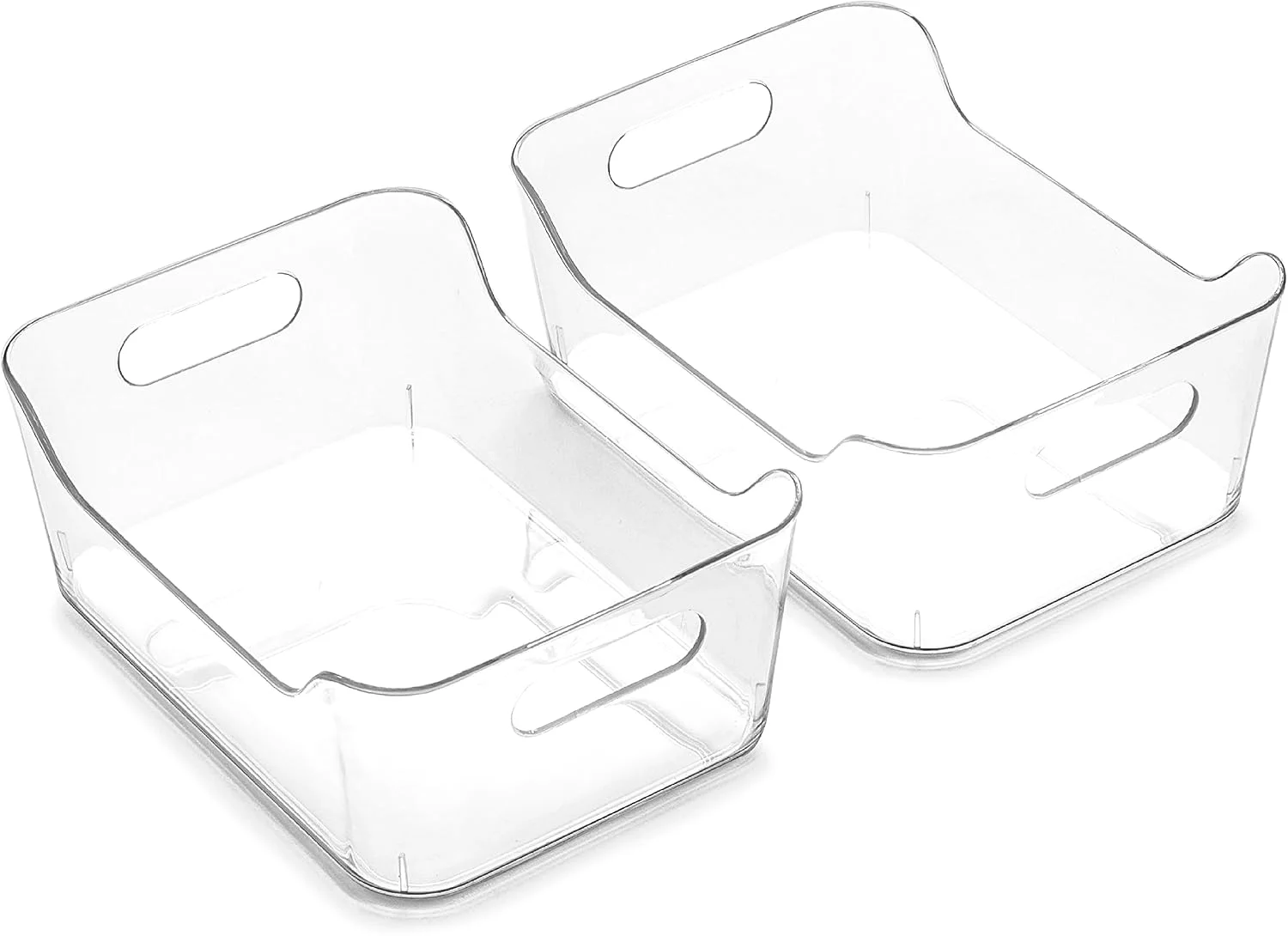
Six numbers decide whether a storage bin fits, and only two of them are printed on the box. A working method for getting the other four.
The most common thing that goes wrong with a storage purchase is not quality. It is a quarter of an inch. The bin arrives, it is the size the page said it was, and it does not go in, because the number on the page and the number in the cupboard were measuring different things.
This is a solvable problem and it takes about four minutes with a tape measure. What follows is the method we use ourselves when we are deciding what sizes to make, written out for the other end of the process: deciding what to buy.
A space is described by three dimensions and a bin by three more, and the fit depends on all six plus one thing that is not a dimension at all. Take them in this order.
The first three are yours to measure and nobody can do them for you. The middle two we state on every product page where we have them. The last one is judgement, and the rest of this piece is mostly about it.
A kitchen cabinet is not a box. It is a box with a frame on the front of it, and on a traditional face-frame cabinet that frame can steal an inch or more off each side of the opening compared with the carcass behind it. The shelf inside is the full width. The hole you have to get the bin through is not.
The practical consequence: measure at the opening, with the door open, at the narrowest point. If the frame is 22 inches across and the shelf behind it is 23.5, the number that matters is 22. A bin sized to the shelf will sit on your counter looking foolish.
Hinges do the same thing in a smaller way, and they only do it on one side. A European hinge cup mounted on the door swings into the opening as the door closes past ninety degrees, so a bin that slides in perfectly with the door flat against the wall then stops the door from shutting.
Measure the hole, not the room behind the hole. Everything else in this list is a refinement of that one sentence.
What we tell people who write in with a cupboard
Width errors are accidents. Depth errors are decisions, usually made in the shop and regretted for years, and they follow from a reasonable-sounding piece of arithmetic: a deeper bin holds more, the shelf is deep, therefore buy the deep one.
What actually happens is that the back third of a deep bin becomes a place where things go to be forgotten. You reach in, you feel around, you take out the front items to see the back ones, and after two weeks of that you stop looking in the back third at all. The bin is full and functionally two thirds the size you paid for.
Two shallow bins front to back beat one deep bin almost every time. You pull the front one out to reach the back one, which is a deliberate movement rather than a rummage, and both stay visible. The exception is a bin you will lift out whole and carry to where you are working, in which case depth costs you nothing.
Fridge organisation is the one place where the tempting arrangement is also the wrong one, and it is worth saying so on a page that also sells fridge bins.
The tempting arrangement is a shelf packed edge to edge and front to back. It looks superb in a photograph. The FDA is explicit that it is a mistake: keep the appliance at 40 degrees Fahrenheit or below, and avoid overpacking, because cold air has to circulate around food to chill it. A shelf packed solid stops the circulation, and the bins are exactly what makes packing it solid so easy.
So the working rule for a fridge shelf is to leave the back row clear and treat a bin as a way of grouping things you reach for together rather than as a way of fitting more in. Measure the depth from the back wall to the inside of the closed door, then subtract two inches and plan to that number.
The second half of that guidance is the one people skip. Wipe spills as they happen, because the bacteria that matter in a refrigerator are the ones that grow at refrigerator temperatures. A bin helps here in a way that is genuinely worth paying for: a spill lands in a bin you can lift out and rinse rather than on a glass shelf you have to empty first.
General food safety information from a public agency, not advice about your particular kitchen and not a safety claim about any particular product.
Clear height is the easiest number to measure and the easiest to use wrongly, because the bin has to come out as well as go in. On a fixed shelf you need the height of the bin plus enough clearance to tip it forward and lift, which for anything with a rim is about an inch.
Two exceptions. A bin on a pull-out shelf or a drawer base does not need lift clearance at all, because the whole shelf comes to you: there you can fill the height to within a few millimetres. And a bin with a lid needs the lid to open, which on a hinged lid means clearance equal to roughly the width of the bin rather than an inch.
Stacking multiplies the problem rather than adding to it. Three stacked bins are three bin heights plus the nesting overlap, and the top one still has to come off. In practice a three-high stack wants around two inches of headroom over the raw arithmetic.
| Space | Typical clear width | Typical clear depth | What usually rules a bin out |
|---|---|---|---|
| Base kitchen cabinet, 24 in | 21 to 22.5 in | 22 to 23 in | The face frame at the opening |
| Wall kitchen cabinet, 30 in | 27 to 28.5 in | 11 to 12 in | Depth, and the shelf above |
| Fridge shelf, full width | 24 to 30 in | 15 to 18 in | Door bins closing on the front row |
| Under a bathroom basin | 20 to 26 in | 14 to 18 in | The trap, right in the middle |
| Wardrobe shelf above the rail | 30 to 48 in | 20 to 24 in | Height to the ceiling, and reach |
| Standard desk drawer | 13 to 20 in | 15 to 18 in | The runner above closing on anything proud |
A shelf above shoulder height and a shelf below knee height are both storage, and neither behaves like the shelves in between. The arrangement that works at eye level fails at both extremes, and the failure is not about fit.
High shelves want handles and want to be light. You are lifting down something you cannot see into, at arm's length, and a bin without a grip has to be pulled by its rim. That is fine at chest height and genuinely unpleasant above your head with something heavy in it. It is also the one place where a lid is a liability rather than a feature: you cannot open it where it sits.
Low shelves want the opposite. You can see into them from above, so clear walls matter less, and depth matters more because pulling a bin out is easy at that height. The thing that kills a low shelf is a bin that does not slide, and the base finish matters more down there than anywhere else.
And on any shelf you cannot see into, the public safety guidance is worth following even if there are no children in the house: keep the heavy things low. The CPSC gives that advice for stopping a tall unit tipping, and it happens to be the same advice for not dropping a loaded bin on your foot.
A summary of public safety guidance about furniture stability, not advice about your particular room and not a claim about any particular product.
Every dimension we publish is the figure we specify for that product, and moulded plastic is made to a tolerance rather than to a number. On a bin the size of a shoebox that tolerance is small, well under a millimetre on any single wall, but it is not zero and it is not honest to imply otherwise.
What that means for you is a rule of thumb rather than a worry: if the gap between your space and the bin is under a quarter of an inch, treat the fit as uncertain and buy the next size down. If it is under an eighth, it will not fit, whatever the arithmetic says, because you also need to get your fingers around the thing to place it.
It also means the number is more reliable than the size name. "Large" is a relative word and it is relative to the rest of that collection, not to the rest of the world. Our large is somebody else's medium. The inches are the same in both catalogues.
Where we do not state a size, the row is left out rather than filled in. That gap is deliberate, and the reason is set out in how we update this catalogue: packaging dimensions and product dimensions are different numbers, and for a four-pack they are very different.
Put together, the whole procedure is short enough to do standing up.
The planner exists because that last step is where the mistakes cluster. Dividing 22 by 6.5 is not hard; remembering to allow for the clearance between four bins and the sides of the cupboard, and to round down rather than up, is the part people get wrong at nine in the evening with a tape measure in one hand.
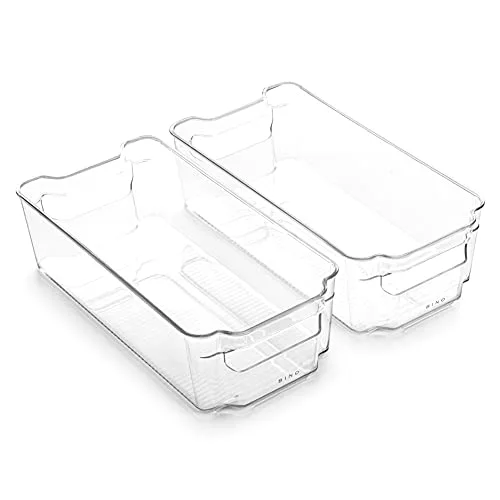
If a shelf is going to hold more than one bin, buying them from the same collection is worth more than it sounds. Pieces in one of our collections share a rim profile and a wall angle, so their sides meet flush. Two bins of the same nominal width from two different families leave a visible ragged gap between them, because the rims flare differently.
That is the practical reason the collections have names at all. It is not branding for its own sake: The Soho and The Stacker are different shapes with different rims, and knowing which one is already on your shelf tells you what to buy next. The full list is on BINO collections, and each collection page carries a table of the sizes we currently state dimensions for.
The companion piece to this one is our piece on clear, frosted and woven, which is about the other half of the decision: not whether it fits, but whether you can see into it.